

On Good Authority: Why trusting the art world often doesn't make cents
Updated: Mar 4
by Liz Publika
When I was a kid, on a brutally cold day in New York City, my father and I went to the Museum of Modern Art (MoMA). While we both love art, at the time, neither one of us had an arts education. Walking around, we came across a lot of artworks. Some were beautiful. Some were provocative. And some threw us off completely. Today, I'd like to touch on one particular work that's part of the latter category.
I cannot remember what it was called, but I can still see it in my mind's eye: a three-foot-tall orange painting about a foot wide, with lots of texture thanks to layers of pigment, much of which hardened into sharp peaks. We didn’t “get it.” But, being fans of Ferris Bueller's Day Off (1986), my dad and I decided to replicate the scene in the film where the protagonists visit a museum and "knowingly" assess the works.
To my surprise, the sheer act of standing there, pretending to know what we were looking at, caused people to gather around and evaluate the work. I don't remember if there was a plaque with an artist statement. I cannot recall what other works were part of the same exhibit. But I remember how our performative behavior influenced others in the room. That experience stuck with me for life.
Had it not occurred, I am certain I would have never thought about that piece of art again. Instead, I keep returning to the experience, analyzing what it means to me decades after the fact. Perhaps it was the first time that I truly understood the power of marketing and its influence over perception. Or, perhaps it was the realization that the work, in this case, was absolutely secondary to the outcome.
Fast-forward to 2016. In It’s Always Sunny in Philadelphia — specifically in season 11, episode 4, unofficially titled “The Art Critic” — the gang tries to scam the art world by passing off one of the character’s doodles as high-end modern art inspired by life’s tribulations. The episode also features the debut of Frank Reynolds’ iconic alter ego, the elite art critic and collector Ongo Goblogian. It was a fun exercise in art imitating art.
But the plot poses a legitimate question that is directly related to my early experience: Is an artwork good because the right people say it’s good? And much like the characters in the show, I think that the answer is in fact, yes. But also, no. I cannot and will not discredit the important works of art historians, conservationists, authenticators, and curators. But I also won’t gloss over the fact that distrust in the industry is certainly valid.
For better or for worse, art critic Robert Hughes (1938-2012) earned a reputation for his unreserved skepticism of art market commercialism and approachable writing “for his target audience of intelligent, nonspecialist readers.” As a witness to the art collecting frenzy of the 1980s, he despised pretense as much as posturing and offered blistering critiques, particularly about the murky intersection of art, money, and celebrity.
He passed away in 2012 but is remembered as one “among the few critics who could break through the practiced esoterism of the art world — all that cultish mystification that gets thrown over Great Works like a thousand-pound dung blanket — and make art matter to everyone.” Hughes’s criticism likely resonated because of how fragile the veneer of sincerity really is in the art business.
I may not agree with everything that Hughes wrote, but I very much respect his devotion to directness; the art world likes its smoke and mirrors and art insiders have even used that knowledge for their own means. For example: In 1998, on April Fool’s Day, musician David Bowie and writer William Boyd invited the art world to attend the launch of Bowie’s art-publishing house and its first book, a biography of artist Nat Tate.
The party was hosted by artist Jeff Koons and attended by “the glitterati of the New York culture world,” which discussed, remembered, and even admired Tate’s work. Except Nat Tate was a complete and utter fiction; the prank would have gone on if a journalist didn’t break the story. ”Something about people being hoodwinked — being tricked and bamboozled — is endlessly alluring, I suppose,” reflects Boyd. True.
But I think there’s more to it. Bowie and Boyd were the “right people.” My father and I were not, but we were in the right context and giving off the right signals; the focus on our faces and the involved nature of our “discussion” suggested we knew something the others did not. It’s fun to wonder if the same behavior would have produced the same outcome outside of an established legacy art institution like the MoMA.
Authority is a big deal. Therefore it’s interesting that within the art world — one that prides itself on having a finger on the pulse of society, on speaking truth to power, on standing up to “the man” — few actually practice what they preach. It would have been easy — no, commendable — to admit that most of the people at that event simply had no idea who Nat Tate was. Instead, authenticity took a nosedive for conformity.
There is a very fine line between art and "bullshit," which is exactly what the It’s Always Sunny in Philadelphia episode was addressing. One of the examples its creators used to drive the point home was the sensationalism of the artist’s statement. The intense pressure to appear a certain way, much like the guests at the book launch, can force someone to abandon their better judgement. That’s a disservice to the discipline.
Explaining the process, really, began with Johanna Bonger when she realized that providing context to Vincent van Gogh’s unique works — like The Starry Night (1889), which people found disturbing — made them more digestible for people who were, at the time, used to more traditional artistic expression. In Bonger’s case, it made sense; Vincent van Gogh did not see or experience the world like others did.
The early 20th century was marked by serious advancements in STEM that revolutionized how we understand the world. This, subsequently, gave rise to new art movements, from Futurism and Dadaism to Constructivism and Abstraction. The conceptual nature of the resulting works, like the readymade Fountain (1917) by Marcel Duchamp, benefitted from an explanation. But these are exceptions, not the norm.
Indeed, the dawn of conceptual art and the explanations behind the work expanded our understanding of art and what it could be. And, indisputably, there is intrinsic value in that. But in the imitations that followed? How much value should we attribute to a conceptual work once the idea has already been presented? At what point does an idea stop being art or an intellectual exercise and morphs into a con?
Money makes things more complicated. An argument can be made that those who are in charge of deciding what’s valuable have an interest in blurring the line between art and bullshit, because it allows for “art flexing.” As art writer Jerry Saltz notes, “we have allowed ourselves to be fooled into thinking that the most exclusive things are the most valuable, and the most expensive things are the most exclusive.”
In art, value has two distinct varieties: cultural and monetary. The Mona Lisa (1503), one of the world’s most coveted and celebrated paintings today, was mostly unknown outside of art circles until it was stolen in 1911, after which it became a household name. The artist who made it, the history around it, and the cultural value that it took on subsequently obviously makes sense. But monetary value is a different beast entirely.
The valuation of modern art is a confluence of factors that often seem arbitrary but follow certain patterns within the art world. Provenance, the artist’s narrative, scarcity, size and medium — all of these play a role. But none carry the authority of institutional validation and market mechanics. Auction results create price precedents, which also separate people into two categories: buyers and everyone else.
In other words, the art's cultural capital lets participants frame financial speculation as refined taste, which signals status. In theory, art is for everyone. In reality, it may not be for you. Artists like Banksy occupy an interesting space between these statuses: in theory, his work is made for the people, but it’s being commodified by the elite. In 2018, his painting Girl With Balloon (2002) was sold for $1.4 million, then it self-destructed.
The act of shredding his work right after it was bought at auction was certainly an interesting choice. Allegedly he did it as a performance art piece criticizing the commercialization of art; ironically, what was left of that painting was renamed Love Is In the Bin and sold for over $25 million at an auction three years later. The justification is that it was the first art work to be created live during an auction — a cultural moment.
The stunt elevated Banksy’s monetary value. To his credit, the artist seems skilled at public relations and at manipulating the value of his own work without the input of middlemen; art advisors are essentially investment advisors for the wealthy. But the stunt reinforces Boyd’s observation — that being bamboozled seems to delight the art world. That would be fine if it didn’t create fertile ground for bad seeds.
As of 2026, convicted fraudster Anna Sorokin is still serving her “house arrest” sentence for scamming and deceiving major financial institutions, hotels, and wealthy individuals between 2013 and 2017. And yet, the art world has already embraced her with open arms. Netflix released a show about her, she’s appeared on Dancing With the Stars, and she has an art agent. Does this make her an artist, or a con-artist who won?
She’s no Gerhard Richter. The 94-year-old German artist has earned his reputation throughout the six decades he’s worked on his craft across different mediums. His highest sale was $46.3 million in 2015, which is still somehow less than Jeff Koons’s Balloon Dog (1994) that sold for $58.4 million two years before that. But Sorokin started making art in 2022, in prison, when an art agent saw a mutually beneficial opportunity.
Author and entrepreneur Spencer Greenberg explains further:
"Most artists who toil away at making whatever they feel the urge to create, or whatever they find beautiful, or whatever they think will make people feel and think, are typically not going to make works that are effective at status signaling. So there is a subworld of artists producing works for wealthy people to use to signal status, and this stuff gets way overrepresented in museums, galleries, and the media relative to its value as art."
Hypocritically, the gatekeepers have conned artists into believing that paid exposure somehow diminishes their efforts. The value of their work, goes the argument, should come from being good artists, solid networkers, and skilled business people — and the credibility will come. But the majority of evidence points to the contrary. Yes, there are the outliers, the few who break through the ranks, but they are unicorns.
“The most prominent aspects of the art world, including galleries, museums, media attention, and even critical acclaim, are actually shaped by buyers and those who cater to buyers, whereas artists tend to play a secondary role,” argues Henrik Hagtved, Boston College professor and author of Money and Marketing in the Art World (2024). In other words, Always Sunny has a valid point.
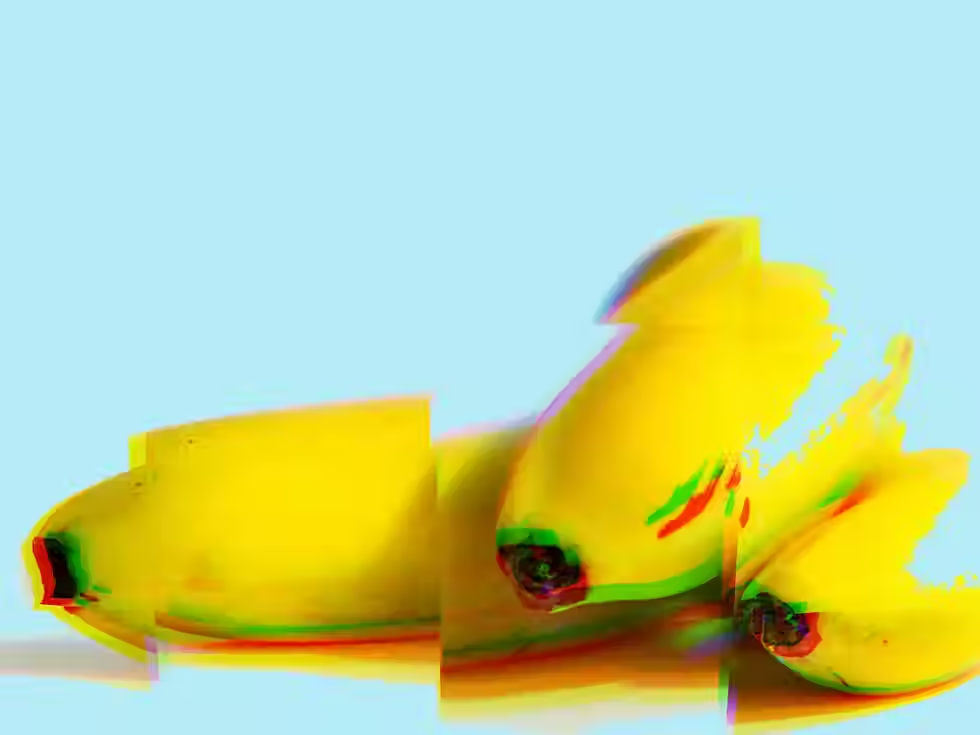
The Comedian, otherwise known as the taped banana that rocked Miami’s Art Basel in 2019, is elitism at its finest. Much like for my dad and me, the context gave off the right signals and was promoted by the “right people,” but this is where art critics and critical thinkers should call out “the man.” To the general public, the sale of the piece feels insulting, because it is. Worse, it justifies cutting arts funding and investment.
The arts need public support to survive. Support often comes from understanding, trust, and respect. But insanely expensive cognitive exercises, the fact that so many successful artists come from success — like hereditary wealth — and the bewildering profit margins of those at the very top of the art world, all suggest that the industry that talks about trust and transparency is neither.
When capital cheapens culture, the best currency is radical authenticity.
Note* Image is The Joker (2026) created by Liz Publika for ARTpublika